








Clinical Rotations In Italy: Tips From A Medical Student
Clinical Rotations In Italy: Tips From A Medical Student
In this article we discuss clinical rotations (tirocini) in Italy. If you are a future medical student and wants to study medicine in Italy – here are some tips for you!
This article was written for future medical students who want to study medicine in Italy and still don’t understand the significance of the clinical rotations (Tirocini). Please read it carefully before choosing a university in Italy to study medicine at.
Hello everyone! Ari is here. In 2019, when I just started studying medicine in English in Italy at the University of Pavia, I was pretty clueless about the significance of clinical rotations and patient interactions. Now, after so many years in Italy and medical school, and many rotations and interactions with different patients, friends who graduated and are now already doctors, and being part of my student organization in my school, I (almost) solidified my opinion about clinical rotations. I wanted to discuss it today in this post.
Clinical Rotations – Why Are They So Important?
When choosing a university, similar to what I wrote in my previous articles (I will link them all under this post so you can read them), many candidates neglect the level of the hospital rotations.
Comparing All Rankings of Medical Schools in Italy!
Read MoreStudy Medicine in English in Italy: The Complete Guide
Read More
After years of experience here in Italy, I decided that the clinical rotations, if you handle them correctly, are even more important than the syllabus and exams you have at the university.
Let me make it a bit clearer. When studying medicine in Italy, you will have a certain syllabus to cover that is pretty standard all over medical schools across Europe. Because it’s pretty much just the theory, you will have many ways to study for exams; there’s plenty of fantastic material online, many good websites, and free resources you can use, watch, or read to know the theory behind things.
The issue is that no book can prepare you to practice what you learned. The best way to see this is to see everything we have learned, such as how doctors treat patients, take history and epidemiology, and physically test the patient for specific signs – all of these are the only things you can do in the hospital.
If you study at a university like Napoli or a southern University in general where the level of the technology and doctors at the hospital is, unfortunately, lower on average (according to many doctors here, who told me that many capable doctors move to the north to cities like Milan, Bologna, Pavia, etc. Some of those doctors and residents were examples; they lived in the South and moved to the North. I was very surprised to see how common it was) adding to the fact that the dialect of the patient in the south makes it almost impossible for us foreign students to understand and get fluent with the patient, the clinical experience is truly lacking.
It’s a shame because this is an important part of medical school in Italy.
It might be a small city in Pavia, but the hospital here is incredible. We have departments and doctors here that patients from all over Italy visit, especially to get diagnosed and treated.
Because we are in the north, many doctors and residents (I keep saying residents because they are doing rotations with you! More about that later on!) speak English well. Many of them (here in Pavia) are always happy to explain the material in English.
I do, however, highly recommend learning Italian from day 1 in Italy; it doesn’t matter which school you choose to go to; if you don’t speak the language, you will get no clinical experience at the hospital, so everything I am writing in this article is relevant to students who put an effort and are at least B1 (basic interactions minimum) in Italian.
What Are “Tirocini” – Clinical Rotations
The Tirocini (rotations) is our name for the clinical rotations in Italy. Here in Pavia, they start from the 3rd year, and they work something like this:
3rd Year
3rd Year – You will have about 6 weeks of rotations in the hospital. These rotations are great for getting you to have basic interactions with patients, take history, and do some semiotics (physical exams on patients like palpitations, auscultation, and basic maneuvers)
4th Year
4th Year – You will have 16 weeks, so about 4 months of rotations in 4 different departments (a month each time). This is when you are also expected to know how to read ECG, prescribe and diagnose basic diseases, and develop a more clinical sense in the hospital.
5th and 6th Year
5th and 6th Year – Here in Pavia, from the 1st year to the 4th year, we study the clinical basics, so by the time you are 5th. Of course 6th, you should have the basics and know how to diagnose and treat many common diseases, read blood work, take a full history, do more complex physical exams like neurological exams, take part in complex tests like spinal tab puncture, radiology, and many more. Many students say that the 5th and 6th years are when you get the most clinical experience, and most students in previous years (3rd and 4th) just shadowed the doctors and residents there and mainly observed without talking much. On the 5th and 6th, you also have a mandatory internship by the government called the “TPV” Tirocinio Pratico Valutativo and Tirocinio Abilitante. Those are around 150 hours of clinical rotations, which are mandatory by the government. They send you to different cities, family doctors, and hospitals to observe and diagnose surgeries. It is part of the internship you must do to graduate and obtain your MD diploma at the end of the 6 years. This is when you gain a huge part of your clinical knowledge.
So, in short, the 3rd and 4th years are mainly for shadowing and observing, while the 5th and beyond years are when we, here at Pavia, expect to gain actual clinical knowledge and experience.
But everything I wrote above was just what the university asks you to do – what about what the university doesn’t ask you? At Pavia, many departments welcome you to do extra-curricular tirocini! You can also find the same thing in most hospitals around Italy. This is where you can be a “mini-doctor”. When you are a good student, and you show interest in a specific niche, nothing stops you from going to a specific department and asking to join, even without having official rotations assigned to you – and this is where you can get plenty of clinical experience in addition to the rounds you must do anyway. (Many students do it when they are locked on a specific department they want to do their specialty or thesis in, which you have to do to graduate).
How To Make The Best Out of The Tirocini as An International Student?
During my first hospital rotations (at the nephrology ward here at Pavia, which was an incredible experience), I was in complete shock. I was lucky enough to have help from other students in the ward and a fantastic head of department (also our nephrology professor). He is the best, most caring, and passionate person I’ve met about his profession. Thanks to that, my rotations there were much easier than they could have been with my level of knowledge and Italian back then.
I have had more rotations since then and have had some better clinical experience over the years, so here is a list of things I would have done differently or made sure to do now if I were in your shoes.
What Should I Expect To See?
In Italy, students are allowed to go to most departments. The idea is to get you to see surgeries, face-to-face consultations, and emergency care. So you get about equal (sometimes not) share of all different not sensitive departments (you won’t be able to go to the emergency care that has people under immediate risk of death, for example). The team you should expect to see would be something like this:
Level 1
Level 1: More students from your year and upper years
Level 2
Level 2: A few residents specialize in that department. Depending on the hospital and ward, some wards rotate residents between different hospitals (so you will have someone going there for 3 months, then moving to the next hospital), while others do the whole 4-5 years there.
Level 3
Level 3: Doctors are responsible for the department. They are usually 1-2 and responsible for that ward, sometimes a bit more if the ward is big, and they are the attending doctors.
Level 4
Level 4: Head of department – the final boss. Depending on the department, you might never interact with them, or they might join and teach you directly the entire time if you are lucky enough to have doctors like that!
So the team that follows you can be quite big; you might end up with 6-8 people in a room with a patient or even more in a surgery room just looking.
It might look weird at first, and you could feel like it’s weird for the patient to be surrounded by so many people who look at them. Still, to my surprise, it’s normal in Italy (in university hospitals) to have so many students during patient visits! (I must admit it’s still a bit weird for me).
You can expect to shadow and look from the side in regular patient visitswhile the doctors work. After 4-5th year, you can also join and ask to do physical examinations. You can look at the charts, learn more about the treatment and diagnosis, and read the lab work.
When going to surgeries – expect to scrub in and watch. If you are lucky enough and the doctors know you, they might teach you how to close up (stitch) and give you a better look at what’s going on inside, show and explain the anatomy while you stand far away from the patient). When it comes to surgeries, even junior residents don’t do much (at least here), so medical students don’t expect to do anything but watch and follow the patient from the beginning to the end.
surgery in medical school hospital rotations
My friend took the picture above during his surgery rotations, where he saw a few liver transplants (and they allowed him to take as many pictures as they liked!
In family doctor visits, you might do a lot – this also happens mainly when you are in your 6th year, so you should know a lot by then and do a lot of clinical examinations. Many doctors will allow you to do most things and correct you when you do something wrong.
Clinical Experience and Skills You Should Try To Get
There’s a list of skills I recommend trying to get during your hospital rotations. If you come up with a specific list of things to do, it can focus you more because it’s easy to feel lost during the rotations. Once you have a checklist of things you can ask to do, the experience becomes much more enjoyable.
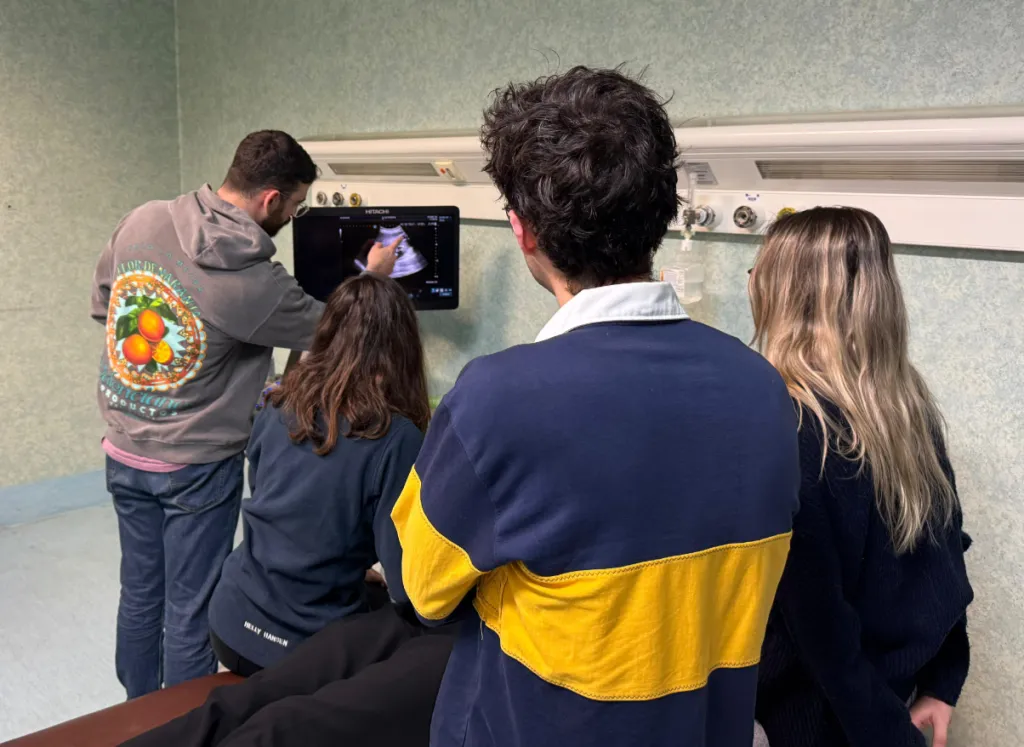
ultrasound laboratory as part of hospital rotations in medical schools in Italy
The picture above is taken from one of the lessons my friends and I delivered to lower years, which allows students to understand how to use ultrasound and gain basic knowledge they can later implement and initiate during the hospital rotations.
My ward checklist · Clinical Rotations In Italy · entermedschool.com
My ward checklist
Skills to Try on Your Rotations
Tick each one once you have done it on a rotation. Saved on this device only.
All six done. Print it for the ward.
Best Way To Approach Doctors with Questions During Your Hospital Rotations
I want you to imagine a situation for a second. Imagine you are a doctor with 20 students every couple of weeks. You need to explain basic things to them, which can get boring. However, from time to time, there are some students who, instead of asking boring basic questions, ask you some more advanced interesting stuff; let me give you some examples and teach you how to stick out.
Instead of asking, “What does this drug do?” open your phone (not in front of the patient, of course), look it up, learn the mechanism and the side effects, then go back to the patient and see if you can recognize some side effect or the effect of that drug, then ask the doctors about the effect/the reason they show/don’t show something that you read. You can also find similar drugs and ask them why we used a certain drug and not others. This way, instead of asking basic questions, you can Google and listen to their opinion and expertise about certain drugs, etc, which is much more interesting.
This is a much more interesting and pleasant experience for you and the doctors. Ask yourself what the doctor can explain to me that I won’t and can’t find by using Google. Those questions make the hospital rotations more interesting – and you also get a chance to listen to what the doctors truly know, understand how they reach diagnosis, which algorithm they consider, and their clinical reasoning. It’s awesome and very interesting to learn.
Who Should I Ask Questions?
From the levels above, I showed you that in every room, you should expect to see when it comes to your team during the clinical rotations. This is also the hierarchy in which you should target your questions. Try asking the nerdiest colleagues first, the upper-year ones who love that department and are always there. If you don’t get your answer, try asking a resident. If they don’t know, they will ask the doctors for you (but usually, the residents know almost everything, so you won’t reach a question they can’t research and answer).
This also applies when it comes to practicing some clinical knowledge. For example, our university didn’t allow us to use ultrasound machines, so although we aren’t technicians or do a residency in radiology, we still teach the basics to lower years because it’s better than no clinical experience. Now that they have the basics, they could go to the next level in the rotations and practice ultrasound properly, as they have the basics – this is the mindset you should develop as well – if you can’t get it from level 4, get it from 3, if 3 doesn’t want to give it to you, get it from 2, if 2 isn’t enough, go to upper years and ask them to teach you something you want to know.
Summary
These are my tips for you as a future medical student in Italy, based on my experience and my friends’. All the opinions in this article were created after spending time in the hospitals and listening to my friends. I will update this article from time to time the more experience I get, but it feels like the tips I gave you here should be more than enough. I also shared my own experience here in Pavia, which I love.
I hope I was able to help, and I wish you the best of luck!
See you soon in Italy,
Ari.