





Hey everyone! Ari is here! In today’s article, we will review the chemistry section of the last IMAT exams to see the drastic changes that section had over the years, allowing you to know what to expect in the upcoming IMAT 2026.
Before we begin, my name is Ari. I have been a medical student since 2019 at the University of Pavia, and I’ve been teaching thousands of students and preparing them for the IMAT exams for the past years! I saw all types of students, and now I am working on rewriting my entire website so you can have the most updated tips regarding the IMAT.
Because Cambridge is no longer writing this exam, the IMAT exam is completely different. This means that courses and websites still rely on old material and give you false information. Please always check the date of the article you are reading to ensure it is the most up-to-date information you can have, especially regarding the IMAT exam, which has had so many changes only in the past couple of years.
Comparing and Analysing Past IMAT Chemistry Sections
Spolier Alert! I am going to use and show some questions from past papers, if you don’t want to look at them, stay away!
Let’s start by understanding how the chemistry section of the IMAT evolved over the years! Like other articles I wrote about the different sections, the chemistry section now has more straightforward questions that are much easier to solve. You won’t find tricky questions or thinking outside of the box; the biology and chemistry section of the IMAT (based on IMAT 2024 and 2023) is very binary – so it’s either you know how to solve them because you studied the material or not.
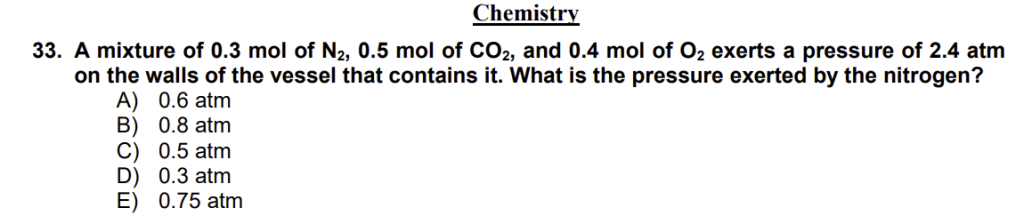
The question above is the best example of the new type of question (the question above is from the IMAT 2024 chemistry section). It’s a simple calculation question of ideal gasses, and there were plenty of similar questions on the exam. Mainly basic calculations without a calculator where you were expected to know a certain formula to solve the question.
Let’s take another question, this time from IMAT 2023:
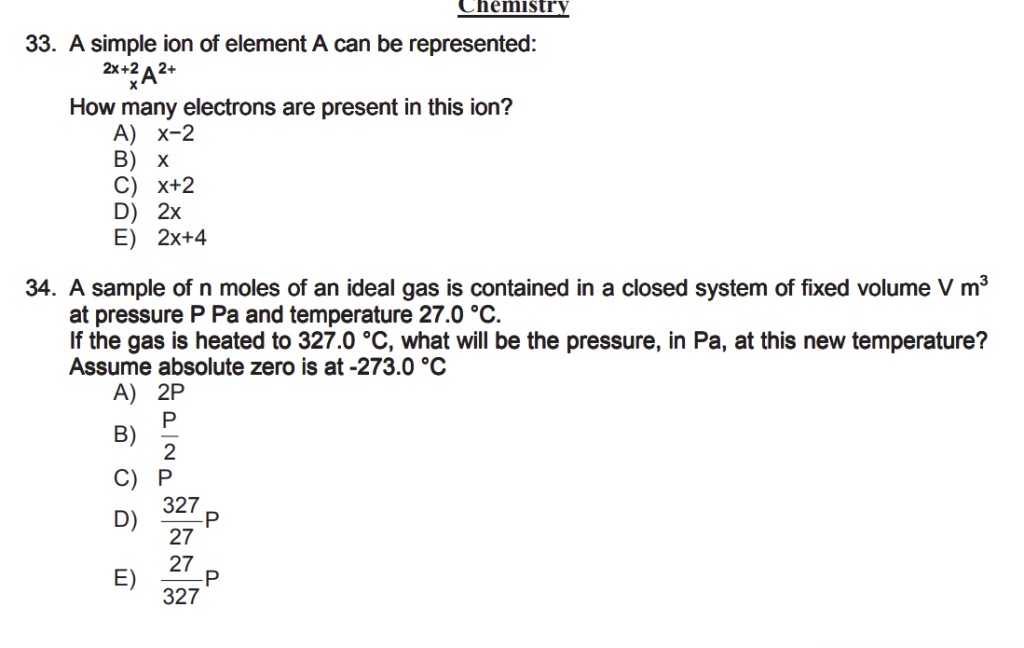
As you can see, similar to the question from IMAT 2024, the chemistry section of IMAT 2023 was also very similar, so we should expect this trend to continue and have similar questions in IMAT 2026.
Now that we have a general idea of the question style let me show you a few questions from when Cambrdige wrote the paper so you can understand what I mean by “significantly different style of questions.”
Here is a question from IMAT 2019, the one I took
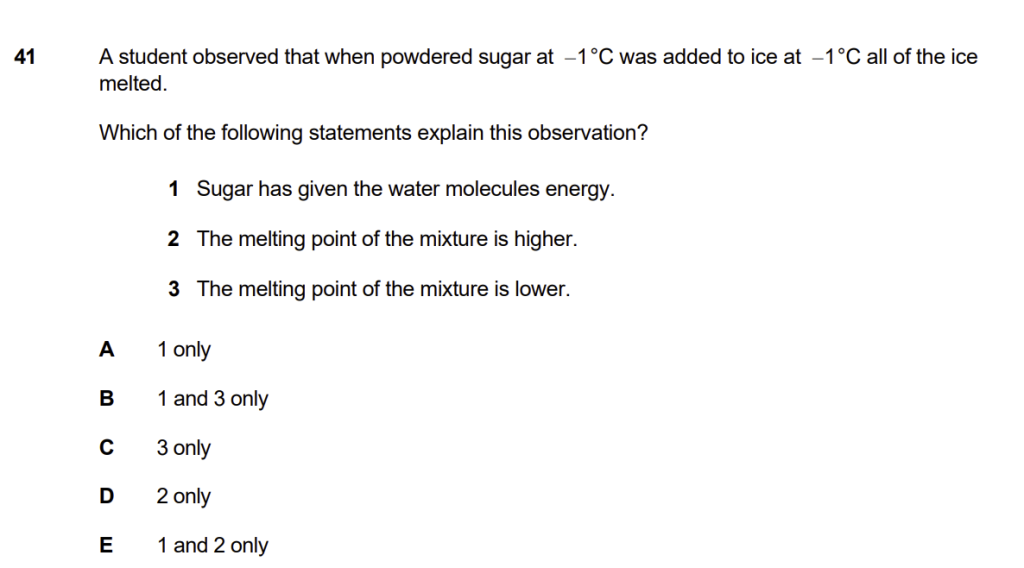
As you can see from the example above, the question didn’t have much calculation, as it was mainly about understanding concepts. This question was hard for most people as they expected questions mainly about calculations, so people who didn’t fully understand the concepts couldn’t solve it.
So, to summarize the main differences you should expect between the old and the new IMAT Chemistry sections, as well as some tips:
- The questions are shorter and mainly based on calculations
- There’s a shift from the basic topics to more questions about redox, acid bases, equilibrium, and gas laws, so know them well.
- Focus on organic chemistry a bit more; organic reactions might appear as part of the more advanced chemistry topics they started asking about.
- Get used to quick calculations without a calculator, and memorize the formulas of all topics to use them quickly on the exam.
IMAT 2026 Chemistry Topic List
Below is the topic list we should expect for chemistry on the IMAT 2026 exam. We will review some of them and give examples from the past papers. Please note that this list is based on IMAT 2024 and is pretty standard, so they will unlikely change anything. However, what changes is what they focus on when asking questions. As you can see, the syllabus of the IMAT is very broad and generic, and it mentions every single topic, but in reality, the focus is on a few topics. A common idea is called the “80-20 rule”. This rule applies here, as 80% of the questions (in biology) are from only 20% of the syllabus. ⚠️As Cambridge no longer writes the exam, we should expect more questions from the more advanced topics such as acid bases, redox, organic chem, stoichiometry, gas laws, and equilibrium. Please review those topics and solve as many practice questions as you can.⚠️
Chemistry Topics for the IMAT Exam (Simplified)
- Constitution of Matter:
- States of aggregation of matter.
- Heterogeneous and homogeneous systems.
- Compounds and elements.
- Ideal Gas Laws.
- Atomic Structure:
- Elementary particles.
- Atomic number and mass number.
- Isotopes.
- Electronic structure of atoms for various elements.
- Periodic Table of Elements:
- Groups and periods.
- Transition elements.
- Periodic properties of elements: atomic radius, ionization potential, electron affinity, metallic character.
- Relationships between electronic structure, position in the periodic table, and element properties.
- Chemical Bonding:
- Ionic, covalent, and metallic bonds.
- Bond energy.
- Bond polarity.
- Electronegativity.
- Intermolecular bonds.
- Inorganic Chemistry Basics:
- Nomenclature and main properties of inorganic compounds: oxides, hydroxides, acids, and salts.
- Chemical Reactions and Stoichiometry:
- Atomic and molecular mass.
- Avogadro’s number.
- Concept of moles and its application.
- Basic stoichiometric calculations.
- Balancing simple chemical reactions.
- Different types of chemical reactions.
- Solutions:
- Solvent properties of water.
- Solubility.
- Main methods for expressing solution concentration.
- Equilibrium in Aqueous Solutions.
- Chemical Kinetics and Catalysis.
- Oxidation and Reduction:
- Oxidation numbers.
- Concept of oxidizing and reducing agents.
- Balancing simple redox reactions.
- Acids and Bases:
- Concept of acids and bases.
- Acidity, neutrality, and basicity of aqueous solutions.
- pH.
- Hydrolysis.
- Buffer solutions.
- Organic Chemistry Basics:
- Bonds between carbon atoms.
- Empirical and structural formulas.
- Concept of isomerism.
- Aliphatic, alicyclic, and aromatic hydrocarbons.
- Functional groups: alcohols, ethers, amines, aldehydes, ketones, carboxylic acids, esters, amides.
- Basics of nomenclature.
- States of aggregation of matter.
- Heterogeneous and homogeneous systems.
- Compounds and elements.
- Elementary particles.
- Atomic number and mass number.
- Isotopes.
- Electronic structure of atoms for various elements.
- Groups and periods.
- Transition elements.
- Periodic properties of elements: atomic radius, ionization potential, electron affinity, metallic character.
- Relationships between electronic structure, position in the periodic table, and element properties.
- Ionic, covalent, and metallic bonds.
- Bond energy.
- Bond polarity.
- Electronegativity.
- Intermolecular bonds.
- Nomenclature and main properties of inorganic compounds: oxides, hydroxides, acids, and salts.
- Atomic and molecular mass.
- Avogadro’s number.
- Concept of moles and its application.
- Basic stoichiometric calculations.
- Balancing simple chemical reactions.
- Different types of chemical reactions.
- Solvent properties of water.
- Solubility.
- Main methods for expressing solution concentration.
- Oxidation numbers.
- Concept of oxidizing and reducing agents.
- Balancing simple redox reactions.
- Concept of acids and bases.
- Acidity, neutrality, and basicity of aqueous solutions.
- pH.
- Hydrolysis.
- Buffer solutions.
- Bonds between carbon atoms.
- Empirical and structural formulas.
- Concept of isomerism.
- Aliphatic, alicyclic, and aromatic hydrocarbons.
- Functional groups: alcohols, ethers, amines, aldehydes, ketones, carboxylic acids, esters, amides.
- Basics of nomenclature.
Past IMAT Chemistry Section Breakdown
Let’s first take the previous IMAT 2024 and check which topics they asked the most last year, and then we can conclude how we could have solved the questions
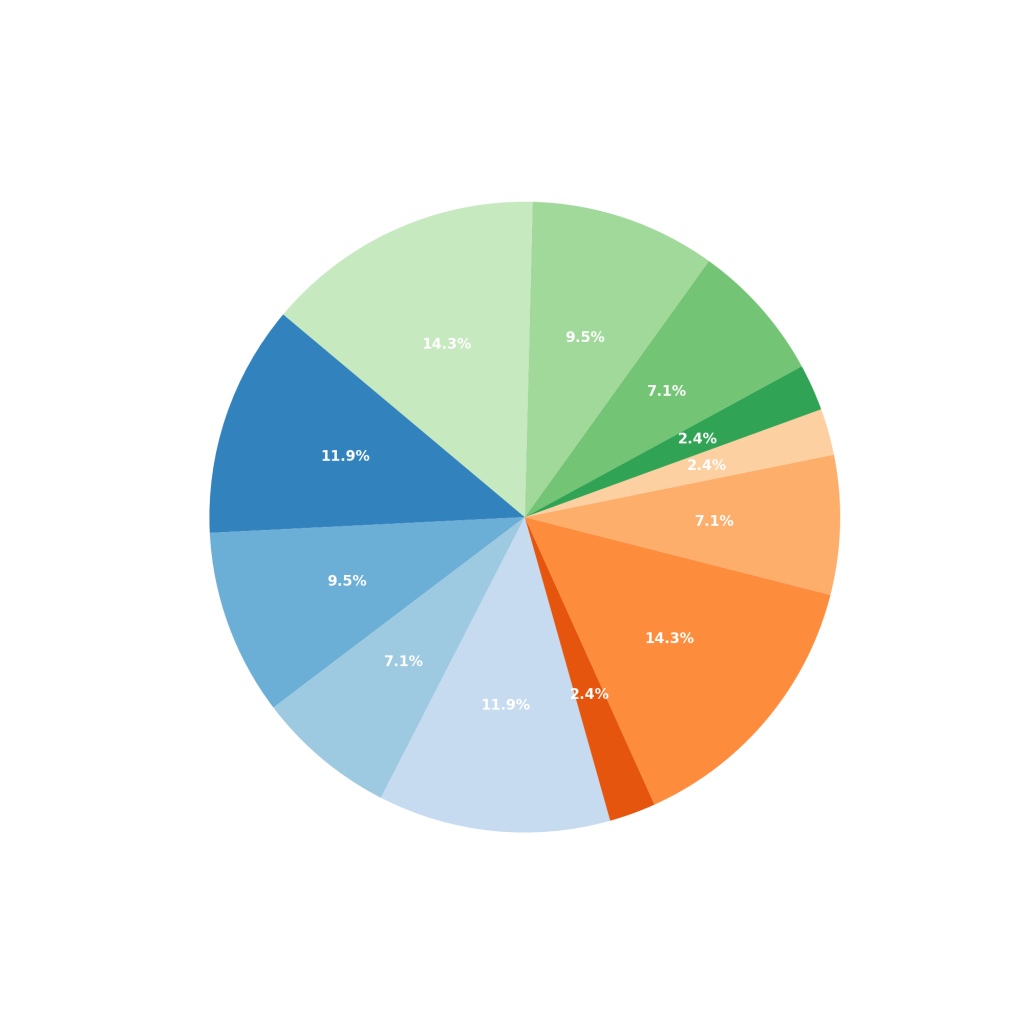
As you can see, there’s quite a big focus on solutions, reactions, stoichiometry, and the basics of organic chemistry. These are very important topics to focus on during your preparation!
IMAT 2026 Chemistry Section Strategy
Past paper · IMAT 2024
IMAT 2024 Chemistry Questions
Word for word from the official paper. Pick an answer, and I’ll show you the working and the trap the paper set.
A mixture of 0.3 mol of N2, 0.5 mol of CO2, and 0.4 mol of O2 exerts a pressure of 2.4 atm on the walls of the vessel that contains it. What is the pressure exerted by the nitrogen?
- 0.8 atm
- 0.6 atm
- 0.75 atm
- 0.3 atm
- 0.5 atm
IMAT 2024, official paper, question 33, page 6free PDFWord for word from the official paper. Answer order shuffled here; in the paper the right answer is always A.
Show the answer and the working
The official answer: 0.6 atm
Explained our way
- What it tests
- Partial pressure
- Key idea
- Each gas pushes in proportion to its share of the moles.
- Step by step
- N2 is 0.3 of the 1.2 mol in the vessel: a quarter.
- A quarter of 2.4 atm is 0.6 atm.
The trap
0.3 atm reads the moles of N2 as atmospheres.
A gas, confined in a rigid cylinder and maintained at a temperature of −3 °C exerts a pressure of 9 atm. What pressure would the same gas exert if it were heated to 27 °C?
- 8.1 atm
- 12.5 atm
- 9.6 atm
- 10 atm
- −81 atm
IMAT 2024, official paper, question 34, page 6free PDFWord for word from the official paper. Answer order shuffled here; in the paper the right answer is always A.
Show the answer and the working
The official answer: 10 atm
Explained our way
- What it tests
- Gas laws at constant volume
- Key idea
- In a rigid cylinder, the pressure follows the temperature in kelvin.
- Step by step
- −3 °C is 270 K and 27 °C is 300 K.
- 9 atm × 300 / 270 = 10 atm.
The trap
−81 atm is what Celsius gives: 9 × 27 / (−3). A negative pressure cannot be right. The 2023 paper sets the same trap in its question 34.
Which of the following compounds forms a hydroxide when reacting with water?
- Cl2O
- SiO2
- BaO
- N2O3
- SO3
IMAT 2024, official paper, question 35, page 6free PDFWord for word from the official paper. Answer order shuffled here; in the paper the right answer is always A.
Show the answer and the working
The official answer: BaO
Explained our way
- What it tests
- Oxides and water
- Key idea
- Metal oxides are basic: with water they make hydroxides.
- Step by step
- BaO is a metal oxide: BaO + H2O → Ba(OH)2.
- The other four are non-metal oxides: with water they give acids (SiO2 does not react).
Given the theoretical reaction yield of 4 FeS2 + 11 O2 → 2 Fe2O3 + 8 SO2 which of the following statements is correct
- To obtain 1 mol of Fe2O3, 2 mol of FeS2 and 5 mol of O2 are necessary.
- From 2 mol of FeS2 and 11 mol of O2, 1 mol of Fe2O3 can be obtained.
- To obtain 1 mol of Fe2O3 and 6 mol of SO2, 2 mol of FeS2 and 9 mol of O2 are necessary.
- From 4 mol of O2 and 11 mol of FeS2, 8 mol of SO2 can be obtained.
- From 10 mol of O2 and 1 mol of FeS2, 3 mol of SO2 can be obtained.
IMAT 2024, official paper, question 36, page 6free PDFWord for word from the official paper. Answer order shuffled here; in the paper the right answer is always A.
Show the answer and the working
The official answer: From 2 mol of FeS2 and 11 mol of O2, 1 mol of Fe2O3 can be obtained.
Explained our way
- What it tests
- Limiting reagent
- Key idea
- Find the reactant that runs out first, then scale the product from it.
- Step by step
- 4 FeS2 need 11 O2, so 2 mol of FeS2 need 5.5 mol of O2: the 11 mol given is plenty, and FeS2 runs out first.
- 4 FeS2 give 2 Fe2O3, so 2 mol of FeS2 give 1 mol of Fe2O3.
The trap
The near miss says 5 mol of O2: 1 mol of Fe2O3 needs 5.5 mol of O2, not 5.
How many mL of water must be added to 15 mL of a 0.25 M solution of H2SO4 to obtain a 0.05 M solution?
- 75 mL
- 30 mL
- 50 mL
- 120 mL
- 60 mL
IMAT 2024, official paper, question 37, page 6free PDFWord for word from the official paper. Answer order shuffled here; in the paper the right answer is always A.
Show the answer and the working
The official answer: 60 mL
Explained our way
- What it tests
- Dilution
- Key idea
- Diluting keeps the moles: C1V1 = C2V2.
- Step by step
- 15 mL × 0.25 M = 0.05 M × V, so the final volume is 75 mL.
- You add the difference: 75 − 15 = 60 mL of water.
The trap
75 mL is the final volume, not the water you add.
How many Na+ ion moles can be found in 250 mL of a 1.2 M solution of Na2SO4?
- 1.2
- 0.4
- 0.6
- 0.3
- 1.8
IMAT 2024, official paper, question 38, page 6free PDFWord for word from the official paper. Answer order shuffled here; in the paper the right answer is always A.
Show the answer and the working
The official answer: 0.6
Explained our way
- What it tests
- Moles of ions in a solution
- Key idea
- Moles = liters × molarity; then count the ions in one formula unit.
- Step by step
- 0.25 L × 1.2 M = 0.3 mol of Na2SO4.
- Each Na2SO4 gives two Na+: 0.3 × 2 = 0.6 mol.
The trap
0.3 forgets the 2 in Na2SO4.
The questions above were the opening questions of the IMAT 2024 chemistry section. As you can see, unlike Cambridge questions, they were short, concise, not tricky, and mainly focused on calculations rather than understanding. Considering that in my personal opinion (please take it with a grain of salt, I concluded it after researching and analyzing many similar exams and all the past papers. However, it’s a prediction, and you must ensure you study as many question styles and topics as you can), the IMAT exam chemistry section will look very similar to what we had last year. The best approach to this topic would be:
- Make sure to follow the free study planner (I will attach a few posts above that you must read; it will give you a better idea before you start studying) – when you reach the chemistry part of the study planner – please make sure to solve all practice questions and not only read the concepts to understand them. (for example, I recently started learning how to ride a motorcycle, so I watched many videos on the theory and technique for proper riding. However, nothing matches the real thing – practice). If you only read and not practice, unlike biology, where you can get through it (at some point, you really have no choice but to solve questions, but you could still solve 60% of the questions without practicing anything), chemistry is completely different. If you don’t practice anything and just read the material from the books and study planner, you will not be able to solve even 20% of the questions – probably even less.
- Find other online resources that contain a lot of practice questions in chemistry (shameless plug to my course that contains enough IMAT-styled questions for 6 months, but you also have plenty of great free resources online with plenty of practice questions – find them, use them, download more books, practice as many questions as you can mainly from the topics that repeat the most.
- Solve all past papers, BMAT papers, SAT practice questions, and IB past papers (which you can find online; many people leak them, but unfortunately, they are copyrighted so that I can link them here). These are good sources for practicing difficult questions, but note that the style of questions might differ slightly from the new, more straightforward IMAT.
- I will publish some free resources for chemistry later this year – make sure to join the WhatsApp communities and get updated once I release them so you can use them! Also, ask other people as many questions as possible and listen to their tips when answering questions and practicing. For example – I got to know about the IB papers back in 2019 when a friend of mine who was also studying for the IMAT and took the IB in the past told me about them – it was a fantastic source to use back then because it was also written by the same company that wrote the IMAT and the questions were pretty much the same. I am sure there are many tips that even I don’t know that you could get to hear from other people who are taking the IMAT exam together with you or who are in my WhatsApp groups/forums helping other students.
- When you practice – try to get used to not using a calculator and memorize all the formulas (then try to see if you actually remember them by solving questions from the practice questions without using a formula sheet or constantly checking to see if you got things right
- Also, when practicing, ensure you only check the answer at the very end, fight the questions, try multiple ways, and don’t give up too quickly. Suppose you are going to solve a question and, instead of seeing it as a challenge, immediately check the worked solution. In that case, you will fail to solve similar questions under exam conditions.
- Also, when practicing, ensure you only check the answer at the very end, fight the questions, try multiple ways, and don’t give up too quickly. Suppose you are going to solve a question and, instead of seeing it as a challenge, immediately check the worked solution. In that case, you will fail to solve similar questions under exam conditions.